

Inside the Bondi Directive: A Secret Domestic Terror List Congress Never Approved
A leaked DOJ memo orders the FBI and JTTFs to compile a constantly updated internal list of “domestic extremist” groups based on ideological markers—creating, in practice, a secret terror-designation


A Murder, Some Bullet Casings, and a New “Domestic War on Terror”
The bullet casings that killed Charlie Kirk weren’t just evidence; they were a storyboard.
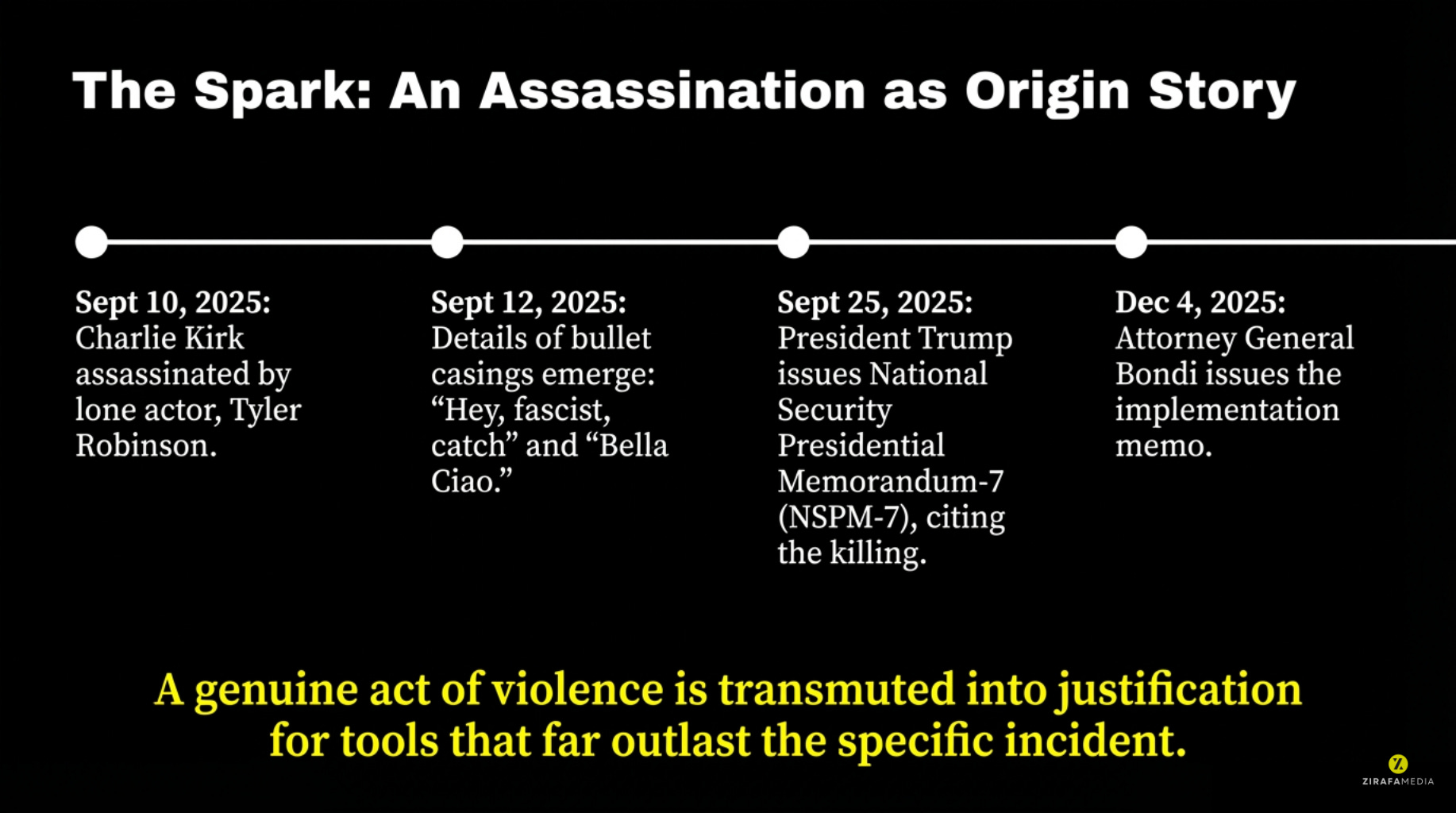
According to Attorney General Pam Bondi, the rounds that tore through the conservative activist on a Utah stage were carved with “Hey, fascist, catch” and “Bella Ciao”—a pointed mash-up of anti-fascist taunt and partisan anthem. In her December 4, 2025 directive to federal prosecutors and law enforcement, those details become Exhibit A in a narrative about a “sophisticated” campaign of left-wing political violence, united by Antifa-style ideology and now demanding a new domestic counterterrorism response.
Buried in the eight pages is the core order: within 30 days, the FBI must compile and maintain a list of groups “engaged in acts that may constitute domestic terrorism,” complete with “disruption strategies,” and update it every 30 days thereafter—with special emphasis on “Antifa and Antifa-aligned” organizations. The criteria for landing on that list read less like a criminal profile than a political litmus test: “opposition to law and immigration enforcement,” “extreme views in favor of mass migration and open borders,” “adherence to radical gender ideology,” “anti-Americanism, anti-capitalism, or anti-Christianity,” and “hostility towards traditional views on family, religion, and morality.”
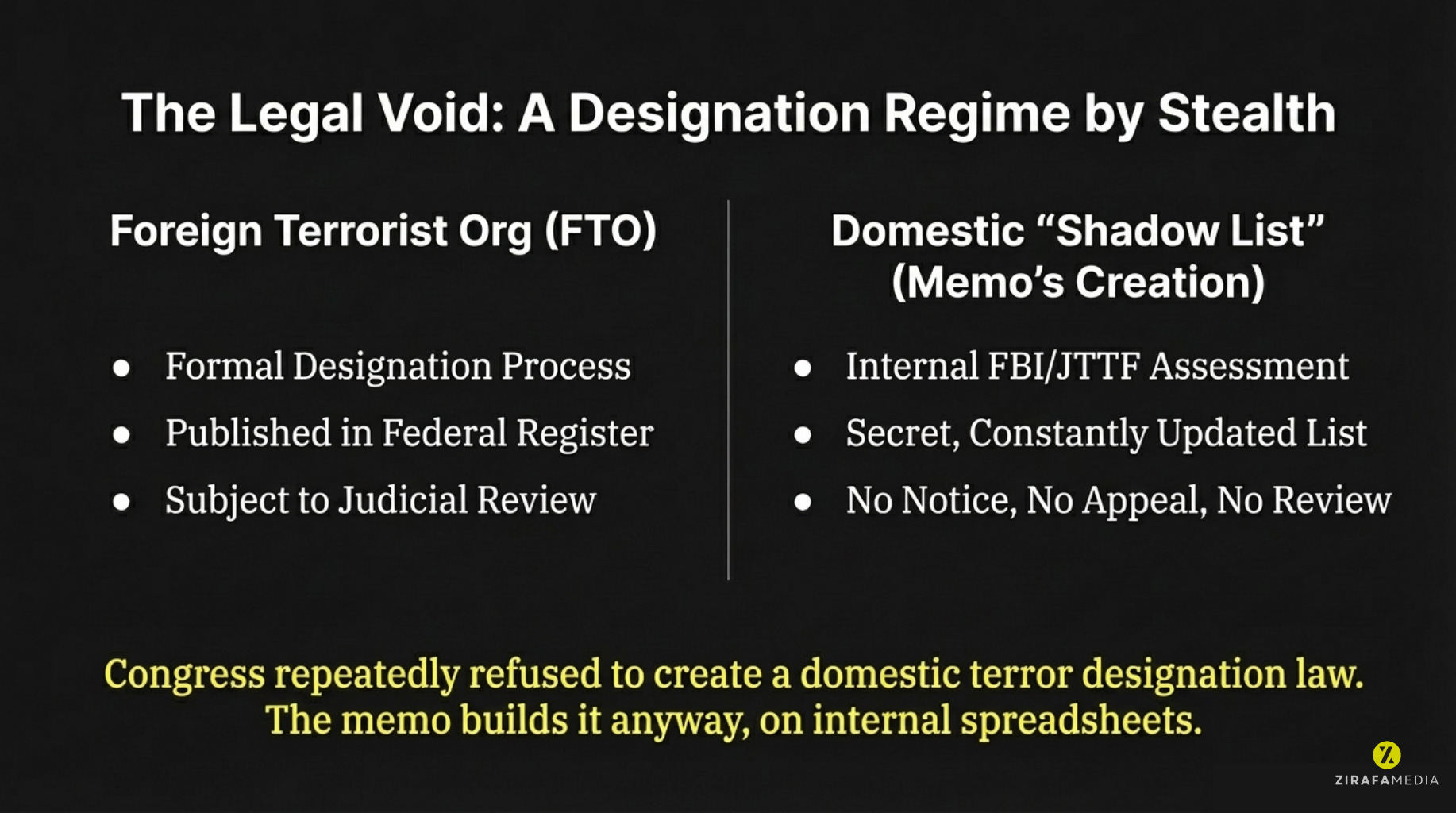
The memo, obtained by Bloomberg Law and reviewed by Reuters, operationalizes President Trump’s September 25 National Security Presidential Memorandum-7, itself issued two weeks after Kirk’s killing. Together, these documents construct something Congress has repeatedly refused to create: a domestic equivalent to the foreign terrorist organization designation—without any of the procedural safeguards that make FTO listings subject to judicial review.
A Domestic Terror Designation Regime by Stealth
This isn’t just about Antifa. It is, in reality, a sweeping expansion of executive power aimed at building the domestic terror designation apparatus Congress explicitly decided was too dangerous to authorize—and filling it with the culture-war enemies you see every night on cable news.
The Bondi memo and NSPM-7 create, in practice, a shadow terror list that behaves like an FTO designation inside DOJ: guiding surveillance priorities, informant deployment, grant allocation, and sentencing recommendations. The list refreshes every 30 days. It drives Joint Terrorism Task Force operations nationwide. It exists on internal spreadsheets and in prosecutorial memos—but never in the Federal Register, never subject to notice-and-comment, never reviewable by a court.
The result is a designation regime in function if not in name. All the rhetorical and investigative power of a “terrorist organization” label. None of the due process.
The Legal Void the Bondi Memo Exploits
Understanding the directive requires understanding what it’s working around.
Under 18 U.S.C. § 2331(5), “domestic terrorism” has a statutory definition: acts dangerous to human life that violate criminal laws, intended to intimidate civilians or coerce government policy through mass destruction, assassination, or kidnapping. But that’s all it is—a definition. The FBI itself calls § 2331 “a definitional statute, not a charging statute.” It creates no criminal offense for “domestic terrorism” and no process for designating a “domestic terrorist organization.”
That gap is deliberate. After the 2019 El Paso shooting and other high-profile attacks, members of Congress floated bills to create a domestic terrorism designation regime. Civil-liberties groups and constitutional scholars across the spectrum warned that such a system would inevitably collide with First Amendment protections for speech and association. Foreign terrorist organizations can be formally listed because they are, by definition, foreign; domestic groups enjoy full constitutional standing.
Congress backed away.
The Bondi memo sidesteps this constraint by treating the FBI’s internal list as an operational tool rather than a formal designation. Groups land on the list not through any adjudicated process, but through the Bureau’s own assessment that their activities “may constitute” domestic terrorism. There’s no notice, no hearing, no appeal.
But the list isn’t just bureaucratic housekeeping. It guides which cases JTTFs prioritize. It shapes which investigations get “all available investigative tools.” And it connects to the terrorism sentencing enhancement under U.S.S.G. § 3A1.4, which adds 12 offense levels and assigns the highest criminal history category—turning a mid-level federal offense that might carry three to five years into a sentence measured in decades.
There is no domestic FTO law because Congress said no. Bondi’s answer: fine, we don’t need a law. We’ll do it on internal spreadsheets and in sentencing memos instead.
The Martyr and the Myth
Every expansion of state security power needs an origin story. For the post-9/11 architecture, it was the towers falling. For the Bondi memo, it’s the killing of Charlie Kirk.
On September 10, 2025, Kirk was shot and killed while speaking at Utah Valley University in Orem, Utah. The shooter, 22-year-old Tyler Robinson, surrendered the following day after his parents recognized him from surveillance footage. Prosecutors charged him with aggravated murder and announced they would seek the death penalty. According to CNN and NPR reporting from September, investigators found text messages in which Robinson wrote that “some hatred cannot be negotiated with”—but no evidence of coordination with any organization.
FBI Director Kash Patel testified before the Senate Judiciary Committee that over 20 users in a Discord group Robinson participated in would be investigated. As of the latest public reporting, no charges have been filed against anyone other than Robinson himself. The picture that emerged was of an online-radicalized lone actor, not an operative in a structured network.
The memo tells a different story.
NSPM-7 and the Bondi directive weave Kirk’s death together with ICE facility attacks, Berkeley street clashes, doxxing campaigns against law enforcement, and threats against Supreme Court justices into a single narrative of “sophisticated” left-wing political violence united by anti-fascist ideology.
The memo instructs law enforcement to treat the killing as the culmination of a coordinated movement and to map the “entire networks” behind such acts. '
Bondi’s language invokes “organizers and funders” as targets, implying an infrastructure that public evidence has not established.
This mirrors a familiar pattern. The Palmer Raids of 1919–1920 were justified by warnings of an imminent Communist uprising that never materialized. Japanese internment rested on claims of coordinated sabotage threats that postwar investigations found baseless. '
The post-9/11 PATRIOT Act and Authorization for Use of Military Force created powers that long outlasted the specific threat of al-Qaeda. In each case, a genuine act of violence or a plausible fear was transmuted into justification for tools that far outlasted the specific incident.
Kirk’s assassination was real and horrifying. But the policy response treats it as proof of something the evidence doesn’t show: that the danger comes from a structured enemy that can be listed, mapped, and dismantled—rather than from the ambient conditions that produce lone-actor violence across the political spectrum.
Building a Composite “Extremist” from Culture-War Positions
Read the Bondi memo’s list of terrorism indicators closely, and a pattern emerges. '
The markers aren’t primarily behavioral—planning attacks, stockpiling weapons, recruiting operatives.
They’re ideological: opposition to law and immigration enforcement, extreme views in favor of mass migration and open borders, adherence to “radical gender ideology,” anti-Americanism, anti-capitalism, anti-Christianity, and hostility towards “traditional views on family, religion, and morality.”
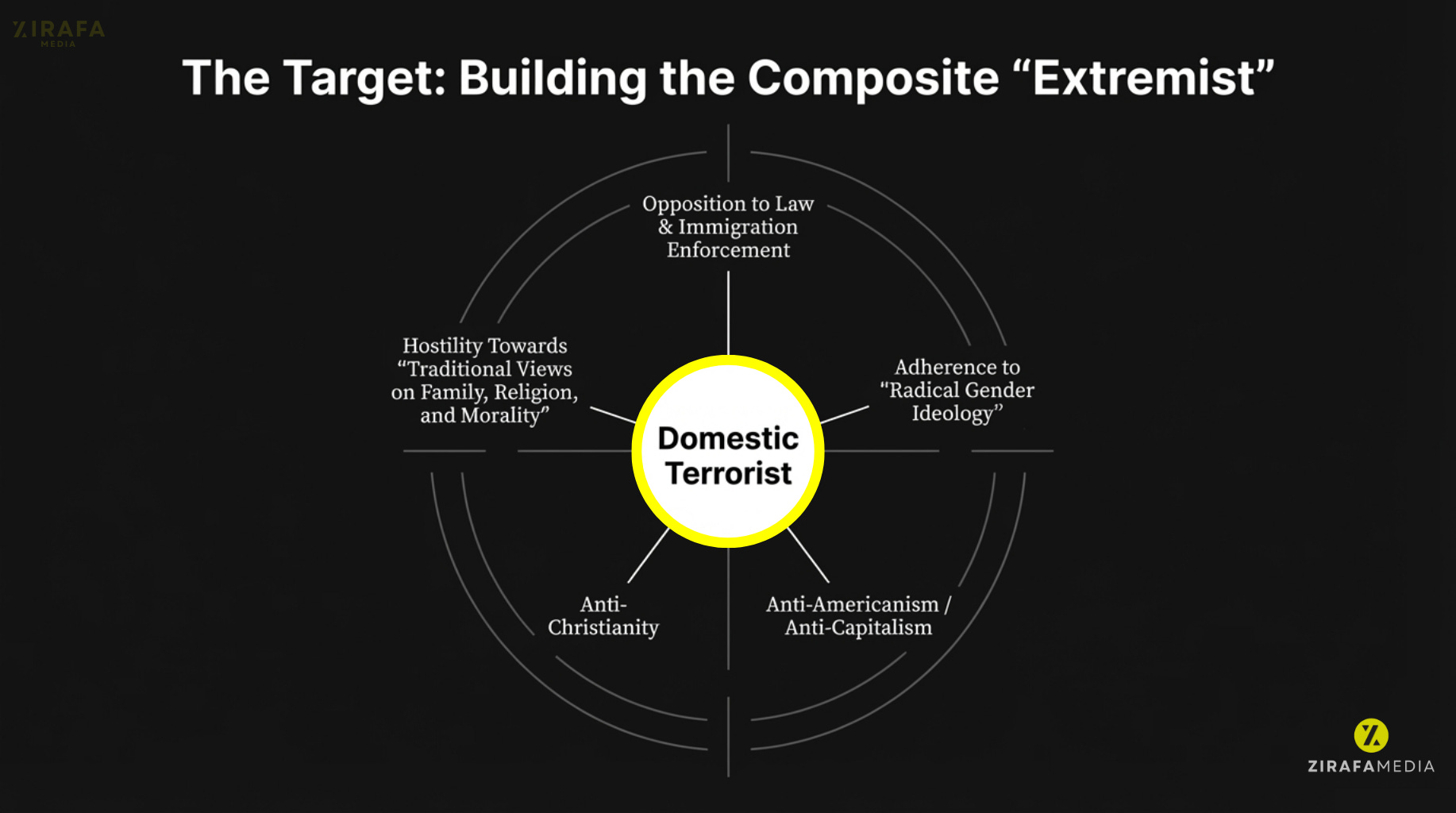
These descriptors don’t define a criminal method. They define a worldview—one that maps almost precisely onto the conservative media caricature of the “woke left.” Immigration advocates, trans rights activists, anti-capitalists, secularists, climate justice organizers, and pro-Palestine movements all find themselves within this frame.
This isn’t about tactics. It’s about constructing a composite version of the culture-war enemy—a single surveillance-ready category that merges distinct movements under one label. Any group that sits at the intersection of these markers can be slotted into the network-mapping apparatus: queer pro-Palestine coalitions, anti-ICE activists, mutual aid networks with anti-capitalist politics.
As Whistleblower Aid’s chief legal counsel Andrew Bakaj put it in a December 5 statement: the memo “expressly seeks to redefine political dissent against the President as domestic terrorism, directing federal law enforcement to treat categories of people as broad as ‘anti-American’ and ‘anti-Christian’ as potential domestic terrorists based solely on their beliefs.”
In that gray zone, conspiracy and aiding-and-abetting tools become remarkably elastic. Once a protest hub, bail fund, legal collective, or media outlet is labeled “Antifa-related” on an internal list, anyone who donates to, collaborates with, or amplifies it risks being sketched in as part of a “network” supporting domestic terrorism. The charging decision may never come. But the possibility—and the investigative dragnet that precedes it—is enough to send a message.
The Self-Sustaining Security Apparatus
The Bondi memo doesn’t just create a list. It builds a system designed to expand.
Retroactive mandate. JTTFs are directed to review incidents from the past five years that “may have involved acts of domestic terrorism”—including doxxing of law enforcement officers, threats against Supreme Court justices, and civil disorder at protests. Activities that occurred under previous legal frameworks can now be recharacterized as terrorism-adjacent and fed into the network-mapping apparatus.
Informant infrastructure. The memo orders the FBI to upgrade its tip line so that “witnesses and citizen journalists can send media of suspected acts of domestic terrorism.” Combined with the ideological indicators, this creates a channel for the public to report neighbors, colleagues, and acquaintances whose political views fit the profile. The echoes—of COINTELPRO’s anonymous letters and infiltrators, of the Stasi’s community informant networks—are hard to miss.
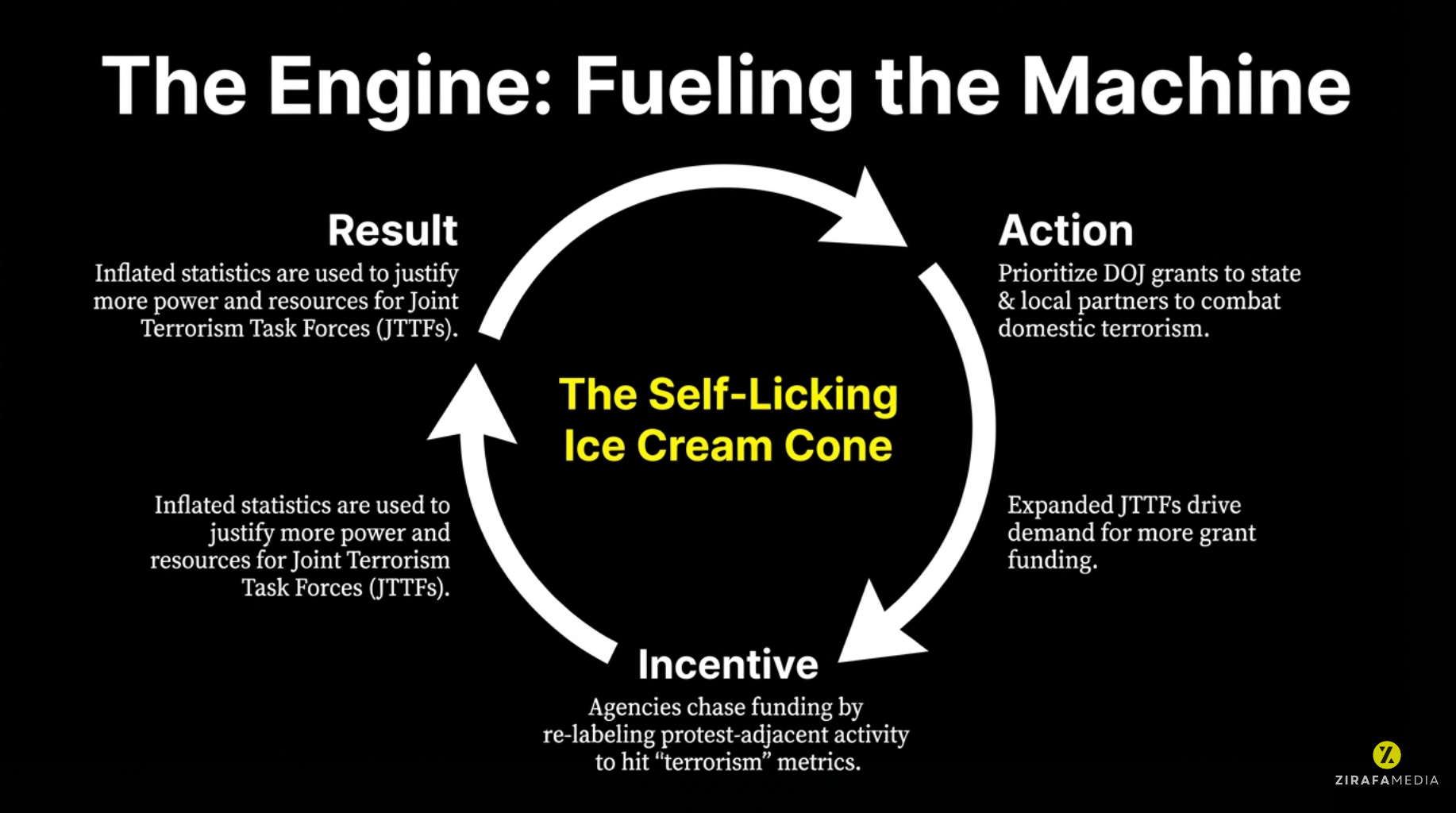
Funding stream. Bondi instructs DOJ grant-making offices to “prioritize awarding funding to states and municipalities that have programs designed to protect against domestic terrorism.” Federal grant history—from Byrne JAG funds to DHS anti-terror grants—shows that agencies chase whatever categories Washington is paying for, then measure success by volume of cases rather than reduction in harm.
JTTF expansion. The Joint Terrorism Task Forces ballooned after 9/11 from roughly 35 units to nearly 200, with personnel growing from around 1,000 to over 4,500 and partnerships extending to more than 600 state and local agencies. That infrastructure never shrank. The Bondi memo now directs it to “use all available investigative tools” to “map the full network of culpable actors” in domestic terrorism—including “organizers, funders, and affiliates” inside and outside the United States.
The logic is circular, what analysts sometimes call a “self-licking ice cream cone.” Define broad ideological indicators as terrorism clues. Fund agencies to chase “domestic terrorism” cases. Re-label protest-adjacent activity as terrorism to hit metrics. Use inflated stats to justify keeping and expanding the powers.
The Church Committee, investigating COINTELPRO in the 1970s, found the FBI had conducted surveillance, infiltration, and disruption campaigns against civil rights leaders, anti-war activists, and feminist organizations—not because they were violent, but because the Bureau considered their ideas dangerous.
The Bondi memo doesn’t resurrect COINTELPRO’s illegal methods. It doesn’t need to. It creates a legal framework that achieves similar ends: network-mapping, informant deployment, and ideological targeting, now with a budget line and a memo header.
Antifa, the Schrödinger Terror Network
The memo’s treatment of “Antifa” deserves special attention, because it reveals how the entire framework operates.
Former FBI Director Christopher Wray told Congress in 2020 that “Antifa is a real thing” but “not a group or an organization. It’s a movement or an ideology.” There’s no membership roster, no headquarters, no central leadership. Local crews with anti-fascist politics exist, but they share a tendency, not a command structure.
Bondi’s directive demands something different. It calls for an intelligence bulletin on “Antifa and Antifa-aligned anarchist violent extremist groups” that addresses their “structures, networks, funding, and tactics.” It orders a list of “Antifa and Antifa-related entities.” It treats a decentralized ideology as if it were a structured organization with identifiable leadership and funding streams that can be mapped, disrupted, and prosecuted.
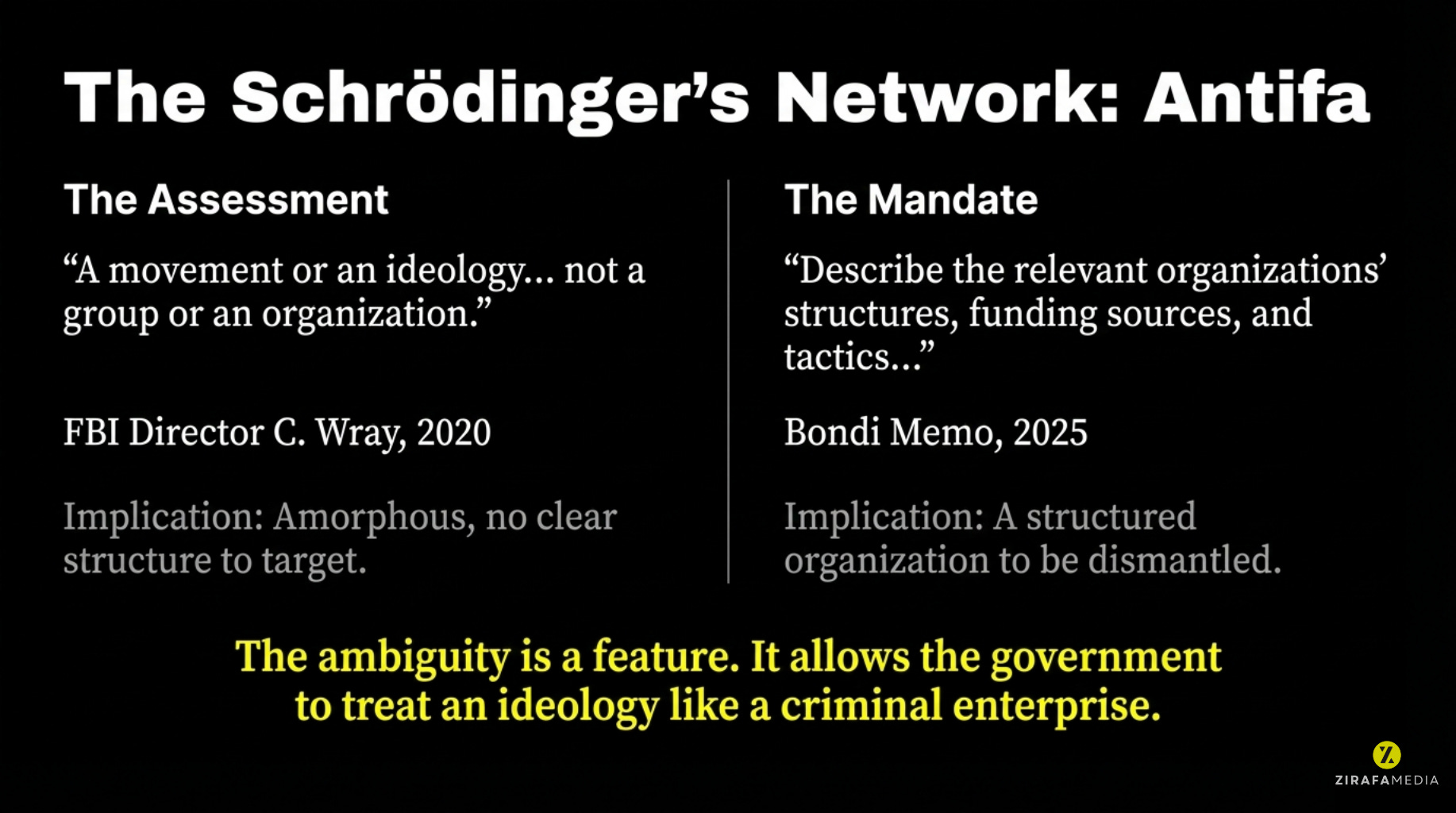
This ambiguity is a feature, not a bug. It allows the government to have it both ways. When challenged legally: “Antifa isn’t a membership organization; we’re just targeting criminal acts, not beliefs.” When talking to political allies or the media: “Antifa is a vast, organized terror network; we have lists of its groups and leaders.”
Antifa is whatever the memo needs it to be: too amorphous to sue, too organized to ignore.
The Best Defense of the Memo—and Why It Fails
Defenders of the directive can make a reasonable-sounding case, and it deserves engagement.
Left-wing political violence does exist. Kirk is dead. ICE facilities have been attacked. Riots caused significant property damage in 2020. Doxxing campaigns have exposed law enforcement officers’ home addresses. The memo, supporters argue, simply prioritizes a genuine threat using tools—RICO, conspiracy charges, terrorism sentencing enhancements—that have been on the books for years. And the document doesn’t criminalize viewpoints per se; it targets acts that “may constitute” terrorism, not beliefs alone.
Fair enough. DOJ has prosecutorial discretion, and prioritization memos are routine. Some violent actors do cluster around anti-fascist, anti-capitalist, or anarchist beliefs.
But that defense sidesteps what makes this memo different.
The focus inverts the documented threat picture. A DOJ-funded study—deleted from the department’s website in September 2025, according to Bloomberg Law—found that far-right attacks, including white supremacist violence, outpace all other forms of domestic terrorism. A 2017 GAO report reached similar conclusions about the post-9/11 era. The memo’s exclusive emphasis on “anti-fascist” ideology suggests target selection driven by politics rather than data.
Then there’s the design problem. A veteran domestic terrorism prosecution expert who reviewed the memo for Bloomberg Law called it “poorly designed” and predicted “unintended consequences once the FBI collects information establishing massive levels of violent right-wing rhetoric.”
The tools, in other words, may not stay pointed in their intended direction—cold comfort if you’re in the crosshairs now.
The deeper issue is structural. The memo doesn’t just prioritize a threat. It reshapes what counts as a threat. The FTO designation process—for all its flaws—requires evidence of specific terrorist acts, organizational structure, and a nexus to designated activities. Groups can challenge their designation in federal court. None of that exists here. The Bondi memo defines the threat primarily by ideological affiliation, creates a list with no statutory basis, and deploys it to guide investigations and sentencing with no external review.
The question isn’t whether left-wing violence exists. It’s whether a shadow designation regime built around ideological markers, with no due process and no judicial oversight, is the appropriate response—and whether the gap between the documented threat and the chosen target tells us something about the memo’s actual purpose.
The Blast Radius: Chilling Effect and Portable Tools
Three implications flow from this architecture.
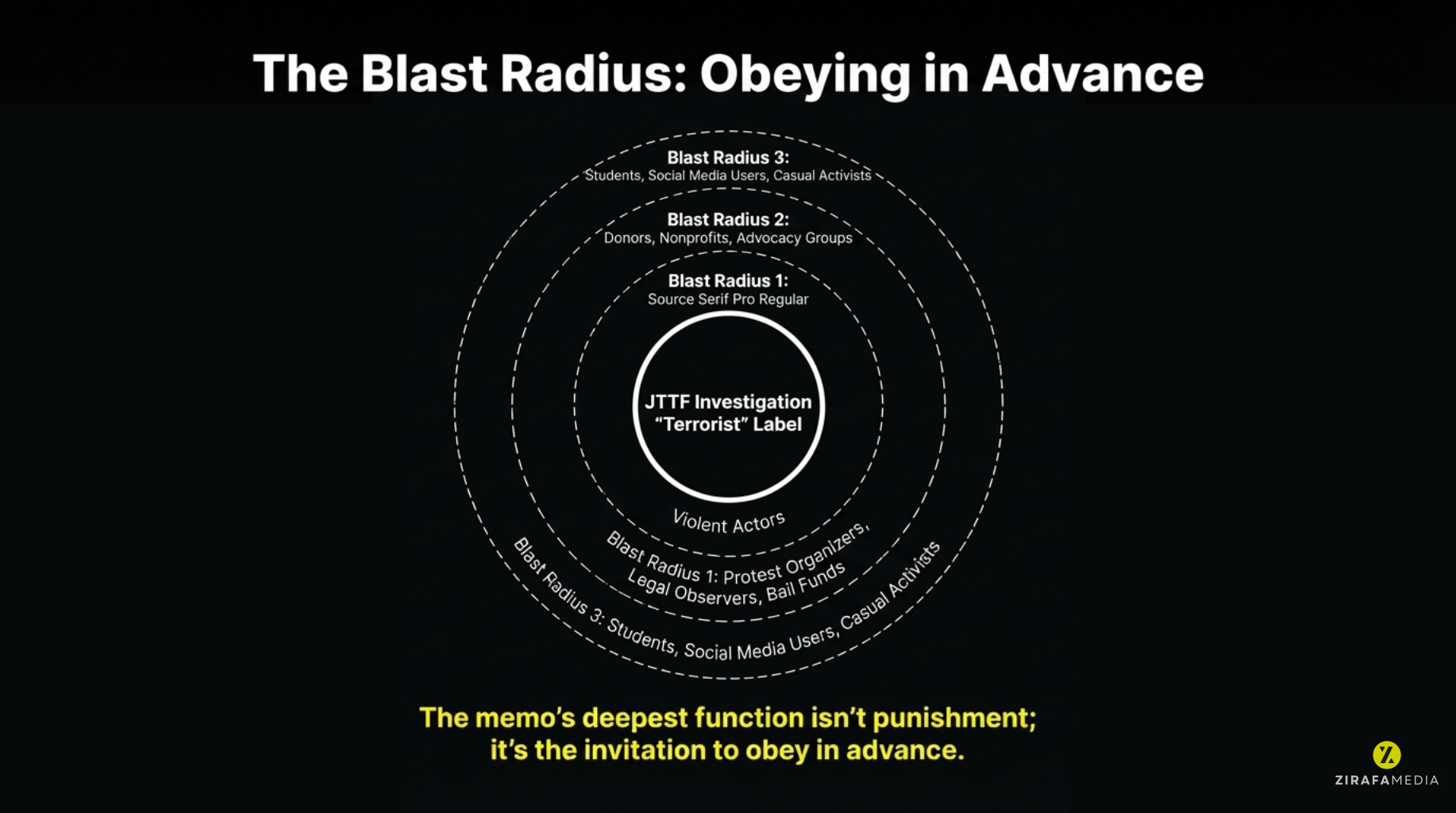
Suspicion radius. Anyone who operates near the ideological bundle—immigration advocacy, trans rights organizing, anti-capitalist politics, pro-Palestine activism, secular humanism—now sits within the investigative blast radius. You don’t need to have committed violence. You need to have attended the wrong protest, donated to the wrong legal defense fund, retweeted the wrong account. The memo’s network-mapping logic treats adjacency as evidence
.
Durability. The JTTFs, the tip lines, the grant streams, and the internal lists will persist. This apparatus doesn’t disappear when administrations change. Today the targets are “anti-fascist” activists and “radical gender ideology” adherents. Tomorrow, under different leadership, they could be gun rights groups, Christian nationalist organizations, or pro-life activists. The precedent is simple and alarming: the executive branch can define your politics as terrorism first and let the lawyers sort it out later.
Obeying in advance. Most people swept into this framework will never face prosecution. They don’t need to. As constitutional scholar Steve Vladeck has argued, frameworks like NSPM-7 are “legally empty but rhetorically dangerous,” designed to make people “obey in advance” even though they create few new substantive rules. The Bondi memo operationalizes that logic. The real power of a shadow designation regime lies in the behavior it deters before any knock on the door. Nonprofits cancel protests rather than risk a JTTF file. Donors quietly pull back from controversial causes. Students skip a march or delete a post rather than gamble on how “radical gender ideology” will be interpreted five years from now.
Signals to Watch
Four developments will determine whether this architecture expands, faces constraint, or gets challenged:
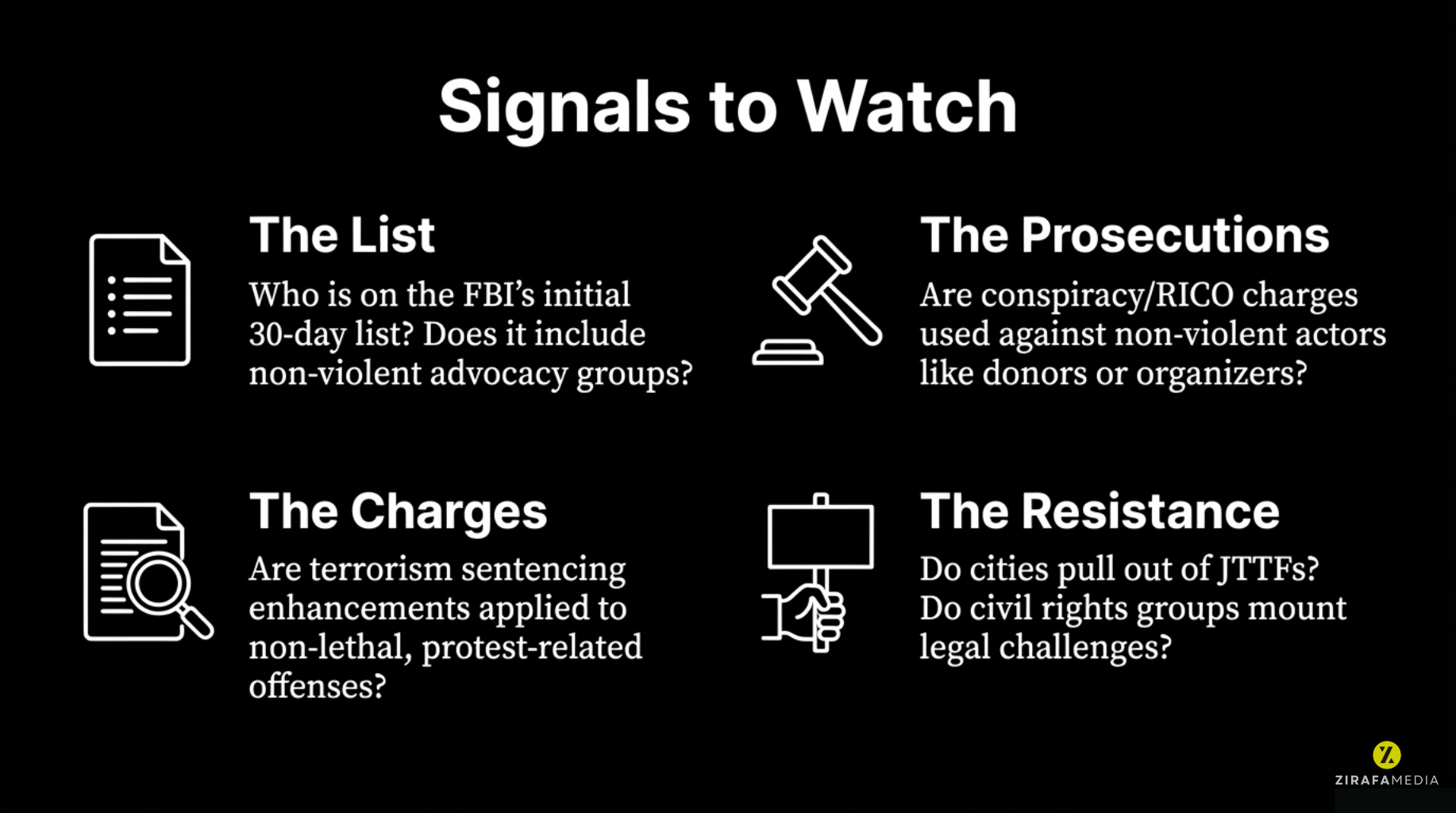
The 30-day list. The FBI’s initial compilation of groups “engaged in acts that may constitute domestic terrorism” will set the baseline. Watch for leaks or FOIA requests revealing how broadly the criteria are applied—and whether advocacy organizations with no history of violence appear.
First prosecutions and who gets swept in. In the first wave of cases citing the memo’s framework, do we see terrorism enhancements or conspiracy charges deployed against donors, legal observers, or loosely affiliated activists—or is the focus kept on clearly violent actors? The legal tools Bondi cites—RICO, seditious conspiracy, conspiracy against rights—are powerful enough to reach far beyond triggermen.
Charging patterns on non-lethal conduct. Separately from who gets charged, watch what charges are used. Are terrorism enhancements increasingly attached to protest-related cases involving immigration, gender, or anti-capitalist activity where the underlying conduct is non-lethal? Charging patterns will reveal whether the memo is being used against violence or against viewpoints.
Grant announcements and local resistance. When DOJ begins awarding anti-domestic-terrorism grants under the new prioritization, track which state and local programs receive funding—and what metrics they use to demonstrate results. Do cities pull out of JTTFs, as Portland and San Francisco did over earlier civil-liberties concerns? Do civil-rights organizations mount challenges using First Amendment association doctrine, citing precedents like NAACP v. Claiborne Hardware? The memo’s durability depends partly on whether it faces friction at the state and local level.
Most people targeted by this framework will never face prosecution. They don’t need to. The memo’s deepest function isn’t punishment; it’s the invitation to obey in advance.
I don't believe a word that Bondi says. Too many lies already.